
How Long Does Body Recomposition Take?
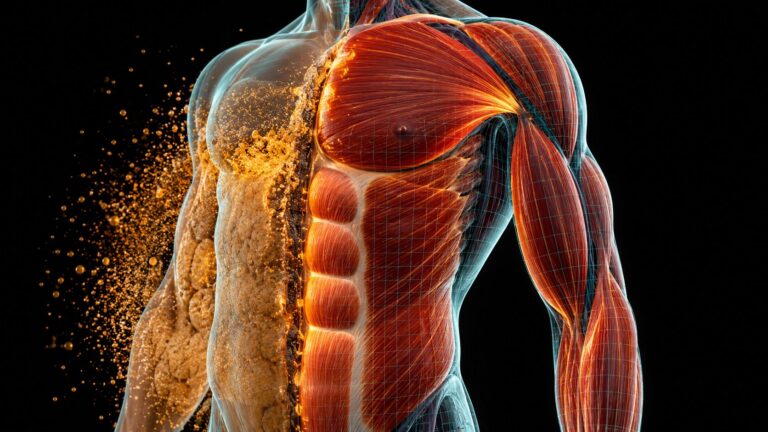
Once you understand how body recomposition works, the next question is almost always the same: how long until you actually see it? The honest answer is that recomposition has no single timeline — it depends heavily on training age, starting body fat, and how consistently you avoid the common mistakes that stall progress. But the research does give us real, usable ranges.
1. Why Recomposition Doesn’t Have One Timeline
Muscle growth and fat loss are governed by different physiological limits, and both are steepest early in training and flatten out as you approach your genetic ceiling. A first-year lifter and a five-year lifter are not playing the same game, even on identical nutrition and training programs — the untrained lifter has a much larger window of “easy” adaptation availableBarakat et al..
This is why the same recomposition protocol can produce visible changes in 6-8 weeks for one person and barely register for another after 6 months. Training age is the single biggest variable in how fast this process moves.
2. Realistic Rates of Change by Training Age
Sports nutrition researchers have modeled approximate monthly rates of muscle gain based on how long someone has been training consistently. These are ceilings under ideal conditions, not guarantees — but they set a realistic expectation.
| Training Age | Max Monthly Muscle Gain | What This Means for Recomp |
|---|---|---|
| Novice (0-1 year) | ~1-1.5% of bodyweight | Fastest visible recomp window — muscle and fat changes can both be noticeable within 4-8 weeks. |
| Intermediate (1-3 years) | ~0.5-1% of bodyweight | Recomp still works well but requires 2-4 months of consistency before changes are obvious. |
| Advanced (3+ years) | ~0.25-0.5% of bodyweight | Slowest window — recomp is real but gradual, often 4-6+ months to see a clear shift. |
| Detrained / Returning | Accelerated (muscle memory) | Can temporarily perform closer to novice-level rates for the first 4-8 weeks back. |
3. What the Actual Research Timeframes Show
Most controlled recomposition studies run for a relatively short window — often 4 to 12 weeks — simply because that’s what’s feasible to fund and control in a lab setting. A well-cited trial by Longland and colleagues found measurable simultaneous fat loss and lean mass gain in trained young men in just 4 weeks on a high-protein diet paired with resistance trainingLongland et al.. A broader review by Barakat et al. found consistent recomposition effects across studies ranging from 4 to 12 weeks in both trained and untrained populationsBarakat et al..
💡 Study Length Isn’t the Same as “How Long It Takes”
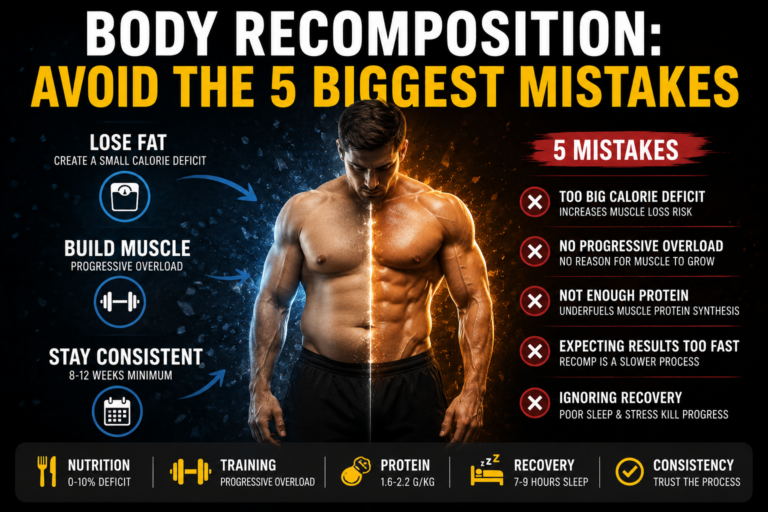
A 4-week study proving recomposition works doesn’t mean 4 weeks is enough to see it in the mirror. It means measurable changes were detectable with lab-grade body composition tools (like DEXA scans) in that window — changes that are usually too small to notice visually or on a home scale that early. Give any protocol at minimum 8-12 weeks before judging whether it’s working for you.
4. Signs You’re Progressing Before the Mirror Shows It
Because the scale is notoriously unreliable during recomp, look for these earlier signals instead of waiting for a visible transformation:
- Strength trending up on your main lifts over 3-4 weeks, even if bodyweight hasn’t moved
- Waist measurement shrinking slightly while strength holds or improves
- Clothes fitting differently in the shoulders/arms while waist loosens
- Progress photos taken every 2 weeks under the same lighting — usually the first place real change becomes visible, ahead of the scale
5. How to Stay Inside Your Fastest Possible Window
You can’t out-train your training age, but you can make sure you’re not needlessly slowing down the timeline you do have availableHelms et al.:
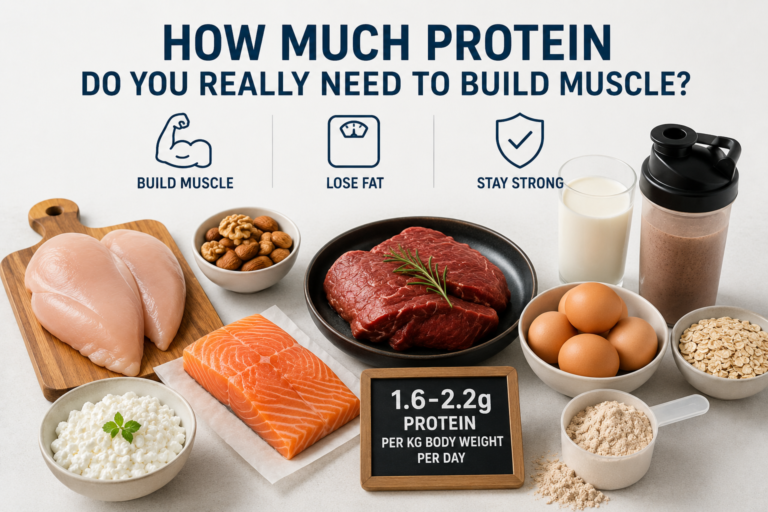
- Protein intake: Stay in the 1.1-1.3g per pound of bodyweight range — see how much protein you actually need to build muscle
- Progressive overload: Without a rising training stimulus, there’s no signal for the body to keep building — see our progressive overload guide
- Consistency over intensity: A moderate protocol followed for 3 months will outperform a “perfect” protocol abandoned after 3 weeks
Use Oneizar’s free macro calculator to set your recomp calorie and protein targets, and track your FFMI every few months to see your muscle-to-height ratio move over time — a more sensitive marker than bodyweight alone.
Track the Signals That Actually Show Progress
The scale lies during recomp — these tools don’t
As an Amazon Associate, Oneizar may earn from qualifying purchases at no extra cost to you.