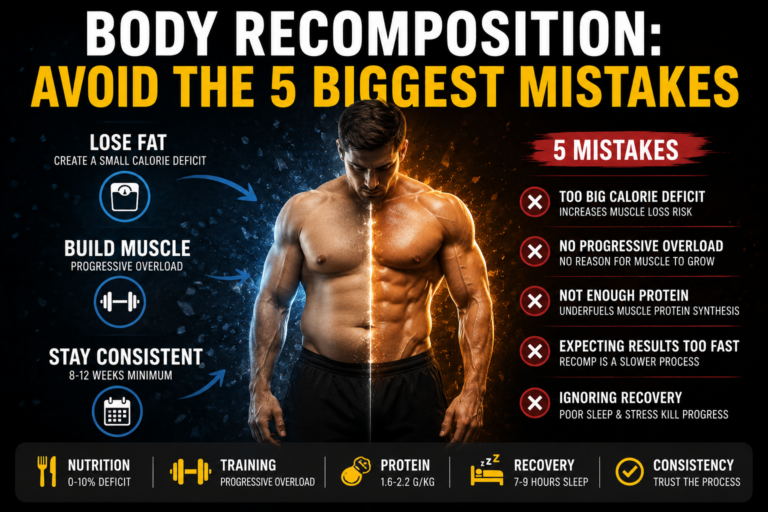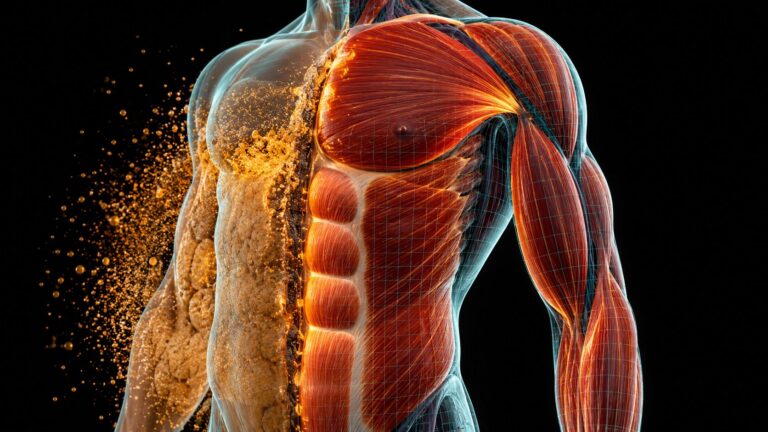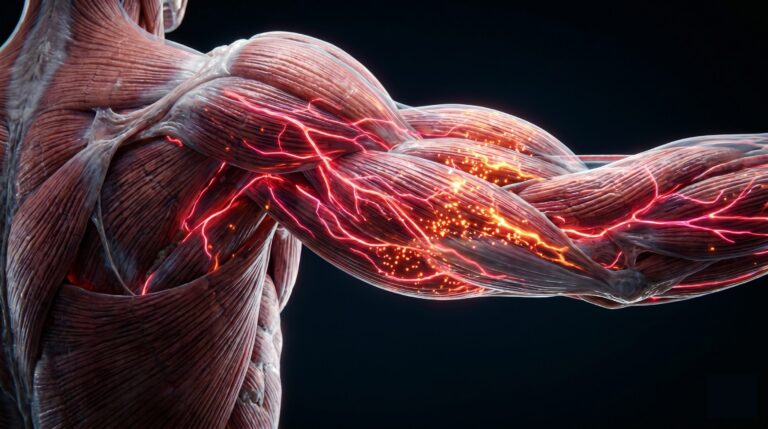

For decades, traditional fitness dogma stated that losing fat and building muscle at the same time was biochemically impossible. You were told you must either “bulk” (eat in a calorie surplus to build muscle) or “cut” (eat in a calorie deficit to lose fat). However, modern exercise science has completely shattered this myth, proving that Body Recomposition is a highly achievable physiological reality. If you want to see the most common ways this process goes wrong, read our body recomposition mistakes guide.
1. The Cellular Paradox: Decoupling Energy from Tissue Growth
The belief that you cannot build muscle while losing fat stems from a misunderstanding of thermodynamics. People assume that because muscle growth requires energy, the body must be in an overall caloric surplus to construct new tissue. This is incorrect.
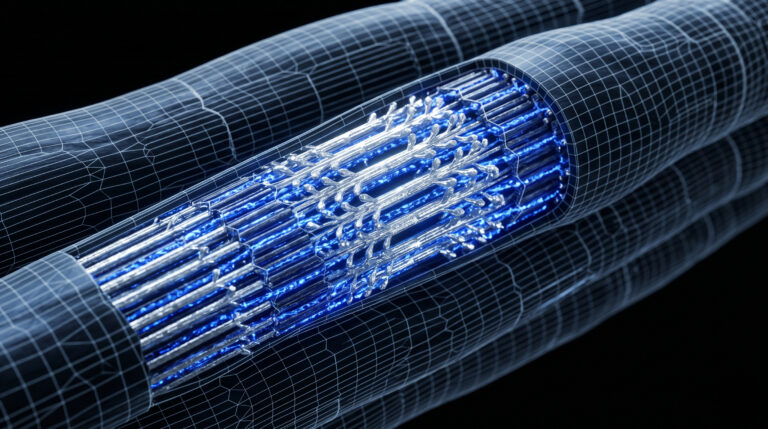
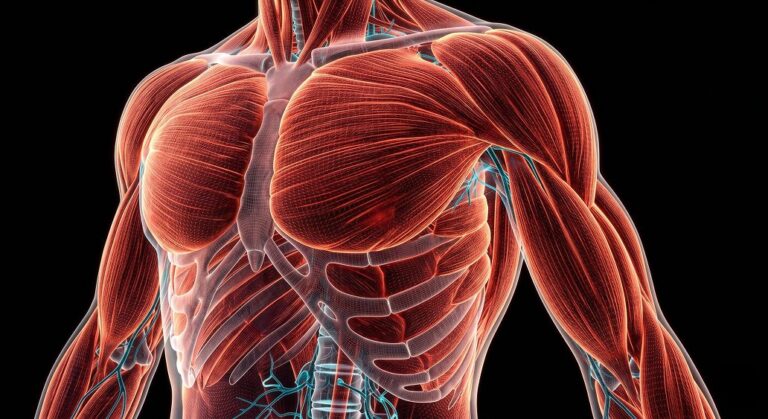
Your body does require energy to trigger Muscle Protein Synthesis (MPS), but that energy does not have to come directly from the food you eat. If you provide a powerful enough training stimulus and consume adequate building blocks (amino acids), your body can easily pull the necessary calories directly from your stored adipose tissue to fund the construction of new muscle fibers. Thus, you burn fat to fuel muscle growth simultaneously.
2. The Energy Window: Small Deficit or Biological Neutrality
To successfully orchestrate body recomposition, the size of your energy manipulation must be meticulous. If your calorie deficit is too deep, your body will prioritize survival over luxury tissue growth, shutting down anabolic pathways. If you eat too much, you will simply store fat.
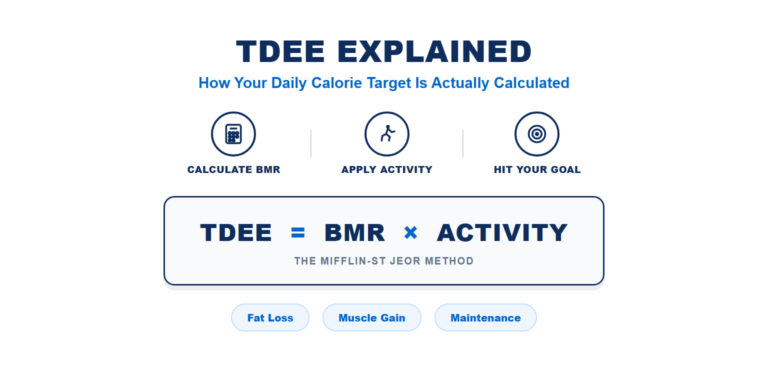
Clinical data highlights that maintaining an energy intake ranging from a 5% deficit to absolute maintenance calories creates the ultimate metabolic ecosystem for recomposition. This precise window forces the body to mobilize fat cells for daily expenditure while leaving enough physiological bandwidth to support resistance training adaptationsBarakat et al.. You can find your personal TDEE baseline in our TDEE and calorie basics guide, or calculate it instantly with the free macro calculator.
3. The Ideal Candidates for Successful Recomposition
While body recomposition is biologically possible for almost everyone, the rate and efficiency of the process depend entirely on an individual’s training status and current body composition metrics.
| Candidate Profile | Recomposition Potential | Physiological Explanation |
|---|---|---|
| Beginners / Novices | Maximum Potential | Unsensitized neuromuscular systems experience rapid, massive spikes in muscle protein synthesis from almost any training stimulus, even in a deficit. |
| Detrained Individuals | High Potential | Due to muscle memory, individuals returning from a long break can rapidly recapture lost lean mass while simultaneously drops body fat percentages. |
| High Body Fat Percentages | High Potential | The body possesses an enormous reserve of internal energy (fat stores). It can safely and continuously draw fuel from these reserves to fully power muscle hypertrophy. |
| Advanced Elite Lifters | Low / Hard Potential | Approaching genetic limits requires highly advanced, granular nutritional pacing and intense progressive overload to see minor changes in dual-tissue optimization. |
💡 Why the Scale is a Deceptive Metric
During a successful body recomposition phase, your total body weight may remain completely stagnant for weeks at a time. If you lose 5 lbs of pure fat and build 5 lbs of pure muscle tissue, the bathroom scale will show a net change of exactly zero. To track true recomp progress, you must abandon the scale and rely on body fat calipers, waist circumference measurements, progressive strength increases in the gym, and consistent progress photos.
4. The Non-Negotiable Recomposition Protocols
To force your body to override its default survival mechanisms and execute a flawless body recomposition, your daily protocol must adhere to three scientific variablesLongland et al.:
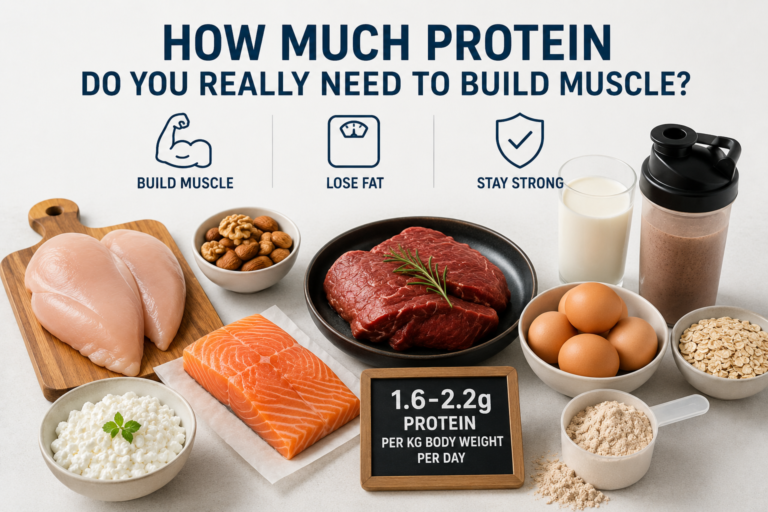
- Elevated Protein Architecture: You must consume between 1.1 and 1.3 grams of protein per pound of body weight (2.4 to 3.0g/kg). This hyper-physiological intake saturates the amino acid pool, constantly fueling the mTOR pathway and protecting lean tissue during transient metabolic shortagesHector & Phillips. See our full breakdown in how much protein you actually need to build muscle.
- High-Tension Resistance Programming: Your training must focus heavily on progressive overload within compound movements. You must provide a clear physiological mandate that forces the body to keep and build muscle tissue.
- Circadian and Recovery Management: Chronic sleep restriction elevates cortisol, which simultaneously downgrades testosterone and increases muscle protein breakdown. Aim for a minimum of 7-8 hours of high-quality sleep to preserve your hormonal baseline.
Need meal ideas that fit this protein-forward, moderate-deficit approach? Try our Naked Chicken Burrito Bowl, Honey Garlic Chicken Rice Bowl, or High-Protein Chickpea Curry for a plant-based option.
Track Real Recomposition Progress, Not the Scale
The measurement tools that actually reveal fat loss and muscle gain
As an Amazon Associate, Oneizar may earn from qualifying purchases at no extra cost to you.